

Well, here’s the thing — words carry weight. When you’re writing an essay, crafting a professional email, or even having a heart-to-heart conversation, the vocabulary you choose can either elevate your message or water it down. That’s exactly why understanding a consequences synonym isn’t just a grammar exercise — it’s a life skill.
The word “consequences” shows up everywhere. From news headlines to courtroom dramas, from school report cards to self-help books — it’s one of those words that does a lot of heavy lifting. But leaning on the same word over and over again can make your writing feel dull and repetitive. Thankfully, the English language is incredibly rich, and there are dozens of vivid, precise alternatives just waiting to be used.
In this guide, we’re going to dive deep into the world of the consequences synonym. We’ll explore various alternatives, their nuances, how to use them correctly, and why expanding your synonym vocabulary will genuinely make you a more effective communicator. So buckle up — this is going to be a rewarding journey!
What Does “Consequences” Actually Mean?
Before we start tossing around alternatives, let’s nail down what “consequences” truly means. At its core, a consequence is a result or effect of an action or condition. It’s the “what happened next” part of any story.
The word comes from the Latin consequentia, meaning “a following.” And that’s a beautiful way to think about it — consequences follow decisions, actions, and events like a shadow follows a person on a sunny day.
Consequences can be:
- Positive – such as rewards, achievements, or growth
- Negative – such as penalties, losses, or setbacks
- Neutral – simply outcomes or results without a strong moral charge
Understanding this spectrum is crucial when choosing the right consequences synonym, because not all alternatives carry the same emotional tone.
The Most Common Consequences Synonyms You Should Know
Here’s where things get exciting! Let’s look at the most widely used alternatives to “consequences,” grouped by their general meaning:
Results and Outcomes
These synonyms focus on what happened as a direct product of an action:
- Result – The most straightforward swap. “The result of the experiment surprised everyone.”
- Outcome – Slightly more formal, often used in academic or professional settings. “The outcome of the negotiation was favorable.”
- Effect – Highlights the cause-and-effect relationship. “The effect of the new law was immediate.”
- Upshot – A wonderfully idiomatic choice that signals a final conclusion. “The upshot of the debate was a complete policy overhaul.”
Repercussions and Ramifications
These synonyms carry a slightly heavier tone, often used when the consequences are serious or far-reaching:
- Repercussion – Suggests an indirect or secondary effect, like ripples in a pond. “The repercussions of that decision were felt for years.”
- Ramification – Often implies complexity and multiple branching effects. “The ramifications of the merger were enormous.”
- Fallout – Borrowed from nuclear science, it’s perfect for widespread negative effects. “The political fallout from the scandal lasted months.”
- Aftermath – Best used after a significant event, often negative. “The aftermath of the storm required massive cleanup.”
Impacts and Implications
These alternatives focus on the influence or significance of an event:
- Impact – Broad and versatile; works in almost any context. “The impact of social media on youth mental health is undeniable.”
- Implication – Suggests something that’s hinted at or suggested, not always stated outright. “The implications of this research are profound.”
- Influence – More subtle, suggesting gradual change. “The influence of good leadership showed in the team’s performance.”

A Comprehensive Table of Consequences Synonyms
The table below offers a handy reference guide for writers, students, and professionals alike:
| Synonym | Tone | Best Used In | Example Sentence |
| Result | Neutral | Academic, casual | “The result was unexpected.” |
| Outcome | Formal | Professional, academic | “The outcome pleased the board.” |
| Effect | Neutral | Scientific, analytical | “The effect was immediate.” |
| Repercussion | Serious | Journalism, legal | “The repercussions were severe.” |
| Ramification | Serious | Legal, political | “The ramifications were complex.” |
| Aftermath | Negative | News, historical | “The aftermath was devastating.” |
| Fallout | Negative | Political, social | “The fallout damaged the brand.” |
| Upshot | Informal | Casual writing | “The upshot? Everyone quit.” |
| Impact | Broad | Any context | “The impact was global.” |
| Implication | Suggestive | Academic, analytical | “The implication was clear.” |
| Sequel | Rare/Formal | Literary, formal | “War was the grim sequel.” |
| Fruit | Positive | Inspirational | “The fruits of her labor shone.” |
| Harvest | Positive | Metaphorical | “She reaped the harvest of effort.” |
| Penalty | Negative | Legal, moral | “The penalty was steep.” |
| Corollary | Academic | Science, logic | “Job loss was a corollary.” |
Lesser-Known But Powerful Consequences Synonyms
Oh, this is where it gets really good. Beyond the everyday alternatives, the English language offers some truly expressive synonyms that most writers overlook. Using these can make your writing stand out like a lighthouse on a dark night.
Corollary
A corollary is a natural conclusion that follows logically from a previous statement or event. It’s popular in mathematics and philosophy but works beautifully in analytical writing.
“Increased unemployment is a corollary of rapid automation.”
Sequel
In the literary sense, a sequel means something that follows from something else. It’s an elegant, old-fashioned choice for formal writing.
“The financial crisis was the inevitable sequel to years of reckless spending.”
Fruit / Fruits
When consequences are positive, “fruit” or “fruits” is a wonderfully poetic alternative. Think of phrases like “the fruits of one’s labor.”
“The fruits of their collaboration were evident in the award-winning product.”
Harvest
Similar to “fruit,” harvest carries a sense of reaping what was sown — perfect for inspirational or motivational writing.
“He eventually reaped the harvest of his years of disciplined study.”
Penalty and Punishment
These are specifically used when the consequences are punitive or disciplinary in nature.
“The penalty for negligence was a $50,000 fine.”
How to Choose the Right Consequences Synonym for Your Context
Here’s the million-dollar question — which synonym should you actually use? Well, that depends entirely on context. Let’s walk through some common scenarios:
In Academic Writing
Stick with formal, precise alternatives like:
- Outcome (especially in research papers)
- Implication (for suggesting broader significance)
- Corollary (for logical connections)
- Ramification (for complex, multi-layered effects)
Avoid casual terms like “upshot” or “fallout” in scholarly contexts unless you’re using them deliberately for rhetorical effect.
In Journalism and News Writing
Journalists love words that pack a punch. Go for:
- Fallout – Great for political and corporate stories
- Aftermath – Perfect for disaster or conflict reporting
- Repercussion – Ideal for stories with delayed effects
- Impact – A go-to for human interest stories
In Creative and Literary Writing
Here’s where you have the most freedom. Consider:
- Fruit / Harvest – For poetic, metaphorical effect
- Sequel – For a literary, old-world tone
- Upshot – For voice-driven, character-based narratives
- Shadow – As a metaphor for dark or looming consequences
In Everyday Conversation
Keep it simple and natural:
- Result
- Effect
- What happened
- Outcome
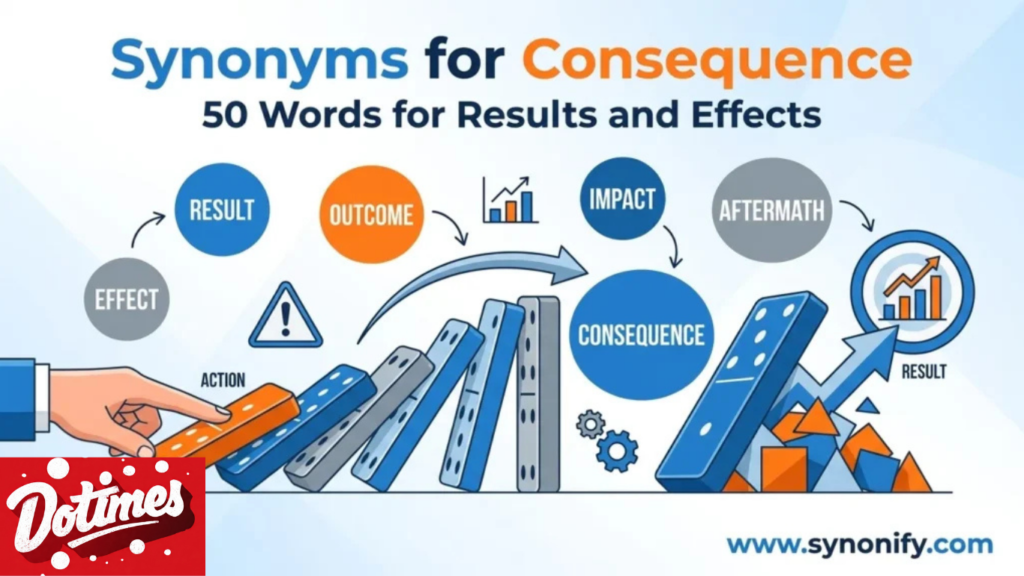
Consequences Synonym in Different Sentence Structures
It’s not just which word you pick — it’s also how you use it. Let’s look at how different synonyms fit into various sentence constructions:
Cause-and-Effect Sentences:
- “As a result of the storm, three villages were evacuated.”
- “The outcome of the election surprised political analysts.”
Consequence-First Sentences:
- “The fallout from the data breach extended well beyond the company.”
- “Aftermath: that single word captured everything the survivors felt.”
Embedded Clauses:
- “Few anticipated the far-reaching ramifications of such a small decision.”
- “The implications of her findings were not lost on the scientific community.”
Idiomatic Use:
- “Every action has its upshot — wise people know this before they act.”
- “She reaped the harvest of years spent building meaningful relationships.”
Tips for Expanding Your Synonym Vocabulary Effectively
Now that you’ve got a solid handle on the consequences synonym landscape, let’s talk strategy. Here are some proven, practical tips for making synonym usage a natural part of your writing:
- Read widely – The more genres you read, the more vocabulary you absorb unconsciously. Newspapers, novels, academic papers, and essays all use different registers.
- Keep a vocabulary journal – Whenever you encounter a new word, jot it down with its context sentence. Review it weekly.
- Use a thesaurus wisely – A thesaurus is a great starting point, but always check the definition of an unfamiliar synonym before using it. Context matters enormously.
- Practice substitution exercises – Take a paragraph and replace every instance of “consequence” with a different synonym. Notice how the tone shifts.
- Write in varied formats – Blog posts, emails, stories, and reports all push you to use different vocabulary naturally.
- Read your work aloud – If a synonym sounds awkward when spoken, it’ll read awkwardly too. Trust your ear.
Common Mistakes to Avoid When Using a Consequences Synonym
Even experienced writers slip up. Watch out for these common errors:
- Ignoring tone mismatch – Using “fallout” in a tender, personal essay can feel jarring. Match the emotional weight of the synonym to the context.
- Overusing formal synonyms in casual writing – “The ramifications of your tardiness are significant” sounds stiff in an informal note.
- Treating all synonyms as interchangeable – “Aftermath” implies something negative and large-scale. Using it for something minor (“the aftermath of skipping breakfast”) sounds exaggerated.
- Stuffing synonyms artificially – Synonyms should flow naturally. Don’t force them in just to avoid repetition if the simpler word fits better.
- Neglecting collocations – Some synonyms collocate better with certain words. We say “far-reaching implications” or “dire consequences” — not “far-reaching upshots.”
The Role of Consequences Synonyms in SEO and Content Writing
For content writers and digital marketers, synonym usage isn’t just a stylistic choice — it’s a strategic one. Search engines today are sophisticated enough to understand semantic meaning, which means using a variety of consequences synonym options can actually boost your SEO performance.
Here’s why:
- Semantic SEO – Google’s algorithms recognize related terms. Using words like “outcome,” “impact,” and “ramification” alongside “consequences synonym” signals topical depth.
- Natural language – Content stuffed with a single keyword reads awkwardly and gets penalized. Synonyms keep prose readable and human.
- Covering search intent – Different users search for different things. Some type “consequences synonym,” others search “another word for consequences” or “results and effects.” A rich vocabulary captures all these variations.
- Engagement – Well-written, varied content keeps readers on the page longer, reducing bounce rates and signaling quality to search engines.
Conclusion
Let’s bring it home. If there’s one thing this guide has made clear, it’s that the consequences synonym universe is vast, nuanced, and genuinely exciting. Whether you’re a student trying to spice up an essay, a journalist searching for the perfect word, or a content writer aiming to improve your SEO game — mastering synonym vocabulary is one of the highest-leverage skills you can develop.
Every word you choose is a decision. And just like, well, consequences — those decisions ripple outward, shaping how your audience thinks, feels, and responds to what you’ve written. So don’t settle for the first word that comes to mind. Dig deeper, explore your options, and pick the synonym that does the most work for you.
After all, great writing isn’t just about saying something — it’s about saying it exactly right. And now, armed with this guide on the consequences synonym, you’re more than ready to do just that.
FAQs
What is the best consequences synonym for academic writing?
The best options for academic writing are “outcome,” “implication,” “ramification,” and “corollary.” These words carry a formal, precise tone that suits scholarly contexts well.
Is “aftermath” always negative?
Mostly, yes. “Aftermath” typically implies the negative or difficult effects following a major event, like a disaster, conflict, or crisis. It’s not usually used for positive outcomes.
Can “result” and “consequence” always be swapped?
Not always. “Result” is more neutral and direct, while “consequence” often implies that the outcome is significant or tied to responsibility. Use them based on the weight of meaning you want to convey.
What’s the difference between “repercussion” and “ramification”?
“Repercussion” suggests an indirect or secondary effect, while “ramification” implies a complex branching of effects. Both are serious in tone, but ramification often hints at more layers of impact.
How does knowing a consequences synonym help in everyday communication?
Knowing various synonyms helps you communicate more precisely and expressively. It prevents repetition, matches your tone to the situation, and signals a higher level of language proficiency — all of which make your speech and writing more persuasive and engaging.